

The Running Grave by Robert Galbraith (2023) — Inside a Cult: Devotion and Deception
Cormoran Strike and the Universal Humanitarian Church


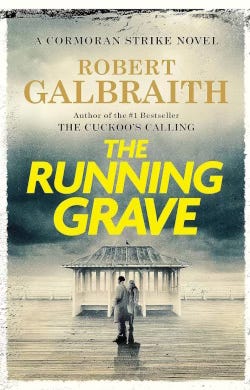
Coming into the series at this point, didn’t feel like the best place to start. Maybe not quite as reckless as beginning Harry Potter at The Order of the Phoenix, but close enough. I expected to feel disoriented. In hindsight, I needn’t have worried. The author (or perhaps the small army operating under the author’s name) provides just enough context for newcomers without subjecting the series' aficionados to tedious recaps.
From the perspective of a long time Strike series reader I am not surprised that picking up a random book from the series didn’t bring about neither the feeling of isolation from the main plot, nor confusion as to the characters’ personalities and chemistry. Just like every Harry Potter book each book in the Strike series provides some background information, which is enough to follow the plot and character development without feeling some deficit. Surely to be up to date on the book’s universe and in-depth character development one is better off then starting with book one (The Cuckoo’s Calling) but if it is this specific story one is after, reading The Running Grave will certainly not leave anyone disoriented.
Cormoran Strike is not your standard private detective; he runs a fully-fledged agency. In this case, he is hired to extract a client’s relative from a cult. A daunting challenge. From the outside the cult looks so unmistakably like… a cult, so it is difficult to imagine how anyone (in their right mind) could be persuaded to sever ties with family and society in order to submit unconditionally to the dictates of a so-called spiritual leader. And yet, the book illustrates this process vividly, showing us the internal machinery of indoctrination through the eyes of an undercover agent who infiltrates the group. It feels like peeling an onion, or descending a spiral staircase into hell.
The cult portrayal attracted me with its if not objectivity than technical submergence. A reader is not offered a judgemental tour of how such an organisation is pure evil, but rather is gradually introduced to its inner workings.
I also enjoyed that Robin’s character isn’t that often used as a lens but rather as a vessel through which various sides of UHC (Universal Humanitarian Church — the cult’s name) is shown. The usage of Robin, a more psychologically oriented of the two partners in the Strike agency, places accents on the features that make UHC so attractive to its potential members. It is through her that we hear Papa J (the cult’s leader) preach the convictions of the cult that are rooted in the values that many wouldn’t rush to brush off. Help to the ones who need it? A belief that compiles the best from every religion? Rehabilitation for the addicted and the lost? The end of world hunger? And of course, the behemoth: the end of capitalism’s reign? Those are some tantalising aims that the UHC brandishes in front of anyone who would stop to listen. While you are reading, you cannot deny the cult’s leader his charisma and intricate understanding of psychology. You are certainly invited by the author to apply critical thinking but also to pause and consider the threat that such a charisma poses.
So how does a cult actually work?
First and foremost, the cult doesn’t advertise itself as such. At the surface it is an organization with the noble mission to make the world a better place. Can’t argue with that. But how much change can a single individual impart? Why squander your life on trivial, self-serving pursuits when you could join forces in the pursuit of justice?
But before changing the world, you must purify yourself. And how can you do that if you still juggle a career, a social life, a family? Such distractions dilute commitment. Dedication must be absolute. The solution is obvious: live in a community of equal minded (and motivated) people. Share space, food, and labour, so every ounce of energy is channelled into the mission.
I am amazed at the way the cult’s doctrine misses out (certainly intentionally) on accentuating the other responsibilities their members have in their lives. Have you ever noticed how a cult, an army or a “highly-demanding job” shifts a person’s interest away from their family if they have one? And the most amazing thing is that the family’s welfare is implied to be reached once you fulfill your duty to them. If you are an exemplary cult member, you have made the world a better place, a soldier — protected your land, your home from the enemy, a worker — ensured a financially secure future for the loved ones. If you look at it right (given, of course, you are a good person) your family will benefit from what you are doing even if they don’t comprehend it now. Well, isn’t it just genius? How many people would have the guts to say out loud that, no, they actually don’t want to change the world for the better?
Naturally, a community requires rules. But not the corrupt rules of the outside world — better ones. And who better to dictate them than the purest and wisest of beings: the leader. Democracy has no place here; initiates are still on their journey, while the leader has already transcended. Submission is natural.
At this point, what from the outside we call “brainwashing” is nearly complete. Life becomes easier once you surrender the burden of choice. You no longer agonise over decisions, you focus instead on your spirituality and your contribution to the group. Exploitation is reframed as virtue. Financial contributions? A duty to support the community that sustains you. Sexual exploitation? A ritual necessary for “higher awareness.” By then, the critical faculties needed to challenge contradictions are already blunted.
And yet, are we really so different? That uncomfortable question lingers. From inside the cult, outsiders appear equally blind, running after careers, mortgages, and empty status symbols, not unlike dogs chasing their own tails.
Which brings us back to the central problem: how to extract someone from such a system. On paper, Strike’s strategy seems simple: have the undercover detective form a bond and persuade the member to leave. In practice, it is nearly impossible. No one can be “deprogrammed” from the outside unless they already carry within themselves a seed of doubt. Fortunately, the character in question does. I will not spoil the details, but it bears repeating: real change is never imposed, it must begin within.
A fair amount of time passed after I finished The Running Grave (just like all the other Strike series novels I’ve experienced it twice: once — in reading, second time — in listening to the audiobooks) and before I read Cultish: The Language of Fanaticism by Amanda Montell. I have been so impressed to realise how well these two books fill in each other’s gaps. One being a fiction and another — a linguistic analysis, they complete each other by providing the technicalities, real life examples and emotions that are better left in the equation when discussing a topic like this one.
One of the most important insights I gained from A. Montell’s book, which was backed up by an authoritative psychologist, is that “brainwashing” does not actually exist. No person can ever be brainwashed. The thing is that when people are convinced by cults to join them in the pursuit of one goal or another, they do so only because they already inherently believe the same things that the cult preaches. That’s why there are people who are much less, if at all, susceptible to cultish convictions — not only because their critical thinking is stronger but because they do not believe or seek the things that a given cult promises them to achieve with its help.
The novel is long — close to a thousand pages — and that length comes not only from the cult storyline but also from multiple parallel investigations. These side cases are not directly relevant to the main plot, but they add texture. We get a sense of what it means not only to be a detective but also a business owner: Strike’s phone is perpetually buzzing, colleagues/employees needing guidance, clients demanding updates, problems proliferating. Even as a reader, I felt smothered by this endless stream of interruptions. It echoed my own working life: emails piling up, messages pinging constantly, a fleeting sense that everything is under control, followed inevitably by the next crisis.
If I have one criticism, it is that the undercover detective never truly falters. She empathises with members of the cult, she feels the grinding pressure of communal life designed to dissolve individuality, but she never once (seriously) doubts her mission. If she had cracked, even momentarily, the story would have gained a sharper edge.
The reasons why Robin did not feel the temptation to join, in my opinion are: (1) she came into the cult with a good understanding of the task in focus — get their client’s relative out; (2) because, citing the psychologist from Cultish, she didn’t have much predisposition to the ways of the cult to begin with. There are more reasons I will not disclose, because I can’t do it without spoiling the plot but some of them have things to do with being a woman in a cult without sexual limits.
And then there is the ending. This is the point where our views diverge the most.
On one hand, the resolution is convenient, almost too convenient. The cult does not collapse under the weight of its own corruption but is dismantled through unrelated allegations. The snake is beheaded, and the body collapses. A neat resolution. Satisfying, yes. Convincing, not entirely. Real life rarely ends so cleanly.
On the other hand, this conclusion is the outcome of a well-done investigation, paired up with journalist contact. The characters in the story are not infallible: there were mess-ups, and big ones for that matter, the only reason why they haven’t led to Robin’s exposure was that they were picked up on either by the people within the cult who were bullied to the point of wanting out, or by cult members who wanted something from Robin. Besides some of her mash-ups were handled by her on a par with cult leaders, due to her psychological training and detective background, which means watching people and learning a thing or two about human psychology.
Again not to disclose spoiler-wise sensitive information, I will only say that if the job was done as thoroughly as the one by Cormoran and Robin with certain legally-related benefits their agency enjoys, I see not many reasons why the story couldn’t have ended the way it did.
One way or another, it is certainly a tale that will help the ones who desire so to submerge themselves into the world of cult psychology and investigation as well as its prequel would — into the world of cyber-investigation. I would certainly recommend The Running Grave and any other Strike series novel to detective aficionados and just fans of meticulous world-building and character development.
 | A guest post by
|